How to up-cycle and uncover the new in erasure, blackout and found poetry.
What is erasure?
Blackout/erasure poetry is a collaboration between the text and the poet/artist. Both depend on each other to exist. Instead of generating words themselves, the author picks and chooses words and makes a poem out of them. The result might look colorful or dull, intricate or simple, beautiful, hideous, or all of the above. Sometimes poets lift the words and place them in their own order to create a whole new poem.
What I love about erasure is the collaborative nature of interpreting and creating. The words are not yours but you have stamped yourself into the work and made something new while honoring or making a statement about the original text. This might be called up-cycling.
Why do it?
It can be fun, and you might discover something along the way. You might learn about your habits, what you steer toward, what you avoid. An erasure can be a reclamation of one’s freedom, a reinstatement of people erased from history. An erasure might just be relaxing. One motivation for me is to prevent a book from going into the trash, which, where I work, is common.
“Rules”
Cite your source. Even if you use a little bit, you should acknowledge your sources. It is respectful and fair. Sometimes, the source is important to know. I’m open to debate.
You might have strict or loose rules that guide you to the words that you end up with. You might have none. Try a variety, see where it takes you.
Here are some resources:
This is a comprehensive research project. It hasn’t been updated in a few years, but most of the links still work. Here, you will learn about the history and uses of erasure. https://www.thehistoryofblackoutpoetry.org/abou
This link involves thoughts on erasure poetry and lhttps://www.wfop.org/a-process-of-illumination-conversations-about-erasure-poetry
https://www.poetryfoundation.org/education/glossary/erasure-poetry
This is a lesson plan for middle school-high school students. It includes discussion of what erasure means and looks at some examples from FELON, by Reginald Dwayne Betts. https://poetry.arizona.edu/education/curriculum/redacted-using-found-texts-re-make-meaning
Some erasures to check out:
Layli Long Soldier’s Whereas, Graywolf Press, 2017.
From the publisher: “WHEREAS confronts the coercive language of the United States government in its responses, treaties, and apologies to Native American peoples and tribes, and reflects that language in its officiousness and duplicity back on its perpetrators.”
Goodreads has a growing list of erasure/found poetry: https://www.goodreads.com/list/show/207013
What I have tried
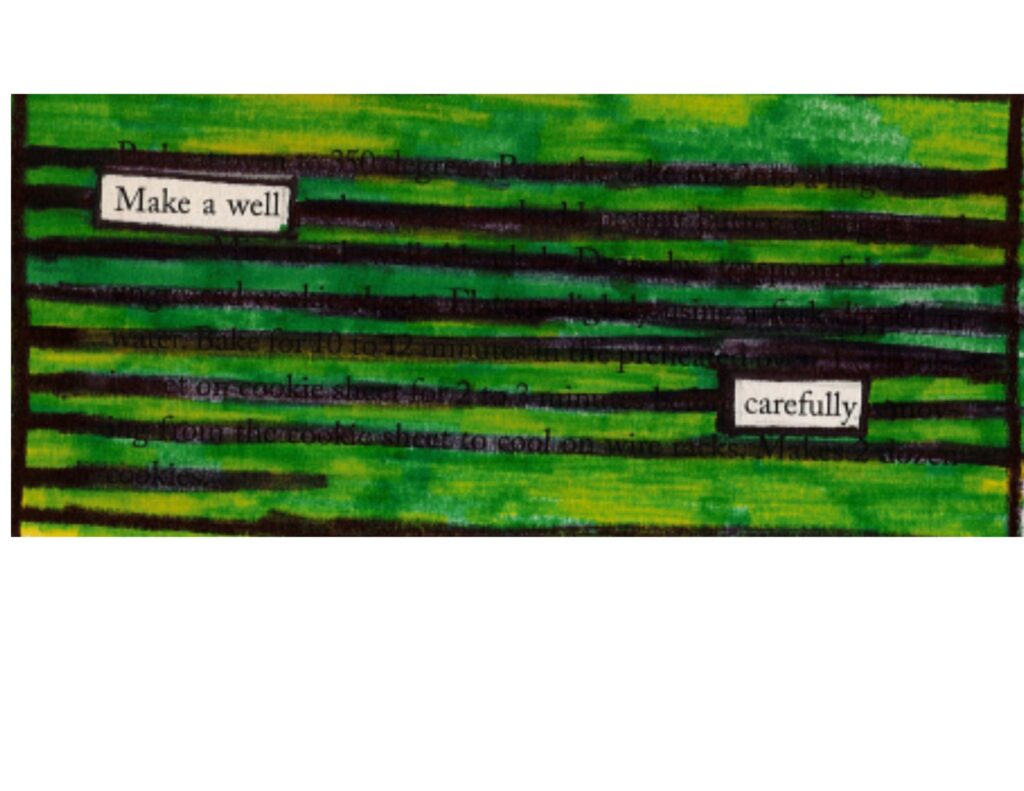
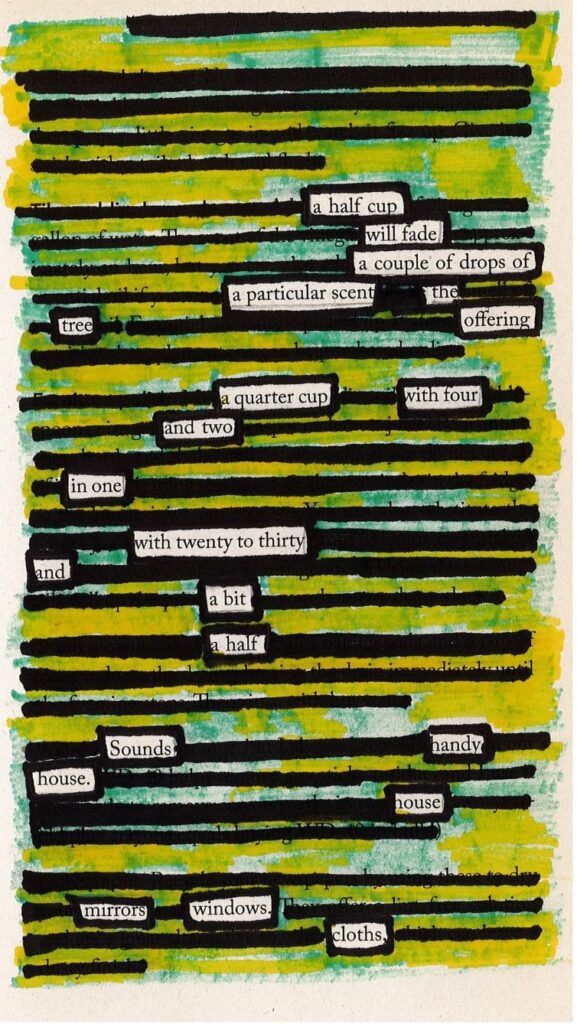
For the past several months, I have been picking and choosing words based on numbers, repeated words, and whatever caught my eye in that moment. I’m seeking inspiration for my own writing, and I’m experimenting with found poetry. The process has been insightful and monotonous. The texts I worked with were Letters of a Woman Homesteader, by Elinore Pruitt Stewart (Mariner Books, 1988) and Changing for Good, by John C. Norcross (Quill, 1994), both of which I rescued from a recycling bin.
I used permanent marker to black out the extra lines, then I colored the page with a dry watercolor pencil, and finally I covered that with marker, which activated the watercolor. This was just fun, and I ended up with some pretty cool colors.